6 Million Refugee Kids Are Locked Out of School—Here's Why It's Getting Worse
William Miller ·
Listen to this article~4 min
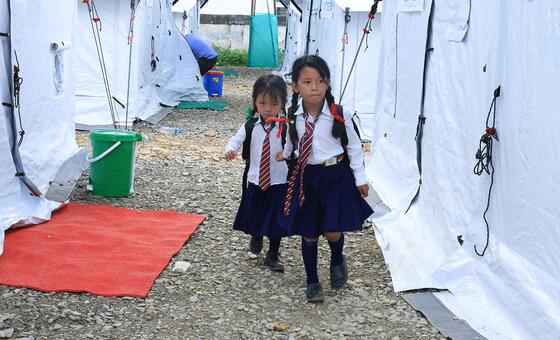
Nearly 6 million refugee children missed school in 2025, and funding cuts could push millions more out. Here's what's at stake and what can actually help.
### The Number That Should Stop Us Cold
Nearly six million refugee children didn't step into a classroom in 2025. Let that sink in for a second. That's not a statistic—it's a generation. The UN Refugee Agency (UNHCR) dropped this news on Friday, and it's the kind of report that should make us all pause.
We're talking about kids who've already lost homes, sometimes families, and now they're losing something just as vital: an education. And the worst part? It's not getting better. It's getting worse.
### Why This Is Happening Now
Global funding cuts are threatening to push even more children out of school. Programs that were finally gaining ground—getting kids into classrooms, training teachers, providing supplies—are now on the chopping block.
Think of it like this: you've been climbing a mountain for years, and suddenly someone yanks away your rope. That's what these cuts feel like to the organizations on the ground.
- Refugee education programs have been expanding steadily since 2020.
- Funding shortages in 2025 have forced closures in multiple regions.
- Without intervention, millions more could lose access by 2026.
### What's at Stake for These Kids
Education isn't just about reading and math. For refugee children, school is stability. It's a routine. It's friends. It's a reason to hope.
When a child can't go to school, they're more vulnerable to exploitation, forced labor, and early marriage. The ripple effects last for decades—not just for them, but for their future communities.
> "Education is the most powerful weapon which you can use to change the world." —Nelson Mandela
That quote gets tossed around a lot, but it hits differently when you realize six million kids are being disarmed right now.
### The Funding Gap Nobody's Talking About
Here's the thing: this isn't a new problem. It's just gotten louder. Refugee education has always been underfunded compared to other humanitarian priorities. But 2025's cuts have turned a chronic issue into an acute crisis.
Countries that host large refugee populations—like Uganda, Bangladesh, and Turkey—are stretched thin. They've been doing the heavy lifting for years, often with minimal international support. Now they're being asked to do more with less.
- Uganda hosts over 1.5 million refugees, many from South Sudan and Congo.
- Bangladesh's Cox's Bazar camps house nearly a million Rohingya refugees.
- Turkey supports around 3.6 million Syrian refugees.
These aren't just numbers. They're classrooms that are closing, teachers who are being let go, and kids who are being left behind.
### What Can Actually Be Done
I know this all sounds bleak. But there are things that work—we've seen them work.
First, flexible funding. Instead of earmarking money for specific short-term projects, donors need to support multi-year education programs. That's how you build sustainable systems.
Second, integrating refugee kids into national school systems. It's cheaper and more effective than running parallel camp schools. Countries like Rwanda and Ethiopia are already doing this.
Third, technology where it makes sense. Not as a replacement for classrooms, but as a supplement. Solar-powered tablets, offline learning apps, community Wi-Fi hubs—these can keep kids learning even when schools are closed.
### The Bottom Line
Six million children. That's roughly the population of Missouri. Imagine every kid in Missouri suddenly unable to go to school. We'd call it a national emergency.
This is a global emergency. And it's not going away on its own.
The UNHCR report isn't just a warning—it's a test. Are we the kind of world that lets six million kids fall through the cracks? Or do we find a way to keep those classroom doors open?
I don't have the answer. But I know which one I'm hoping for.