After Colombia's Quake, a City Digs for Hope With Bare Hands
Felix Braun ·
Listen to this article~5 min
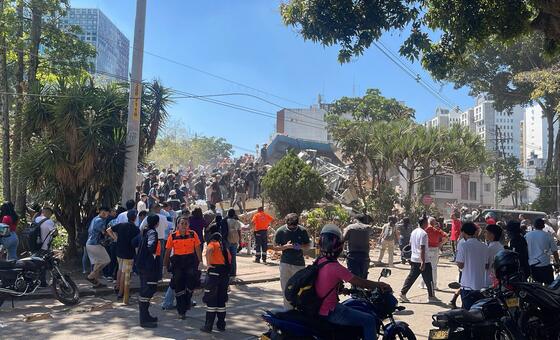
After the earthquake in Cali, Colombia, hundreds still wait for news of missing loved ones. Rescue teams and ordinary citizens dig through rubble with bare hands, racing against time to find survivors.
When the ground started shaking in Cali, no one could have predicted the scale of what was coming. The earthquake that struck Colombia left entire neighborhoods in ruins, and now, days later, hundreds of people are still waiting for news about missing loved ones — parents, siblings, friends, neighbors. The search for survivors continues, but it's not just professional rescue teams doing the work. Ordinary people are showing up, often with nothing but their bare hands, to dig through debris and call out names into the silence.
It's a scene that feels both heartbreaking and strangely inspiring at the same time. You've probably seen the footage on the news — collapsed buildings, dust hanging in the air, people standing in stunned silence. But what the cameras don't always capture is the quiet, relentless determination of the community. In Cali, that determination is everywhere.
### The Human Toll in Numbers
Let's put this into perspective. The quake, which registered at a magnitude that scientists are still refining, struck with little warning. In the hardest-hit areas of Cali, officials estimate that over 400 buildings suffered significant damage. Here's what we know so far:
- At least 1,200 people were injured, with many still receiving treatment in overcrowded hospitals.
- More than 300 individuals remain unaccounted for, according to local emergency services.
- Roughly 15,000 residents have been displaced, many of whom are now sleeping in temporary shelters set up in schools and community centers.
Those numbers are staggering, but they don't tell the full story. Behind each statistic is a family holding onto hope, a friend refusing to give up, a neighbor who remembers exactly where someone was standing when the earth moved.
### Bare Hands and Broken Concrete
The most striking thing about the rescue effort in Cali is how much of it is being done by civilians. Professional rescue teams are stretched thin, working around the clock with trained dogs and acoustic listening devices. But they can't be everywhere at once. So, in the gaps, regular people step in.
You'll see a baker who closed his shop to help clear rubble. You'll see a college student who skipped classes to bring water and bandages. You'll see grandmothers organizing food lines, and teenagers using their phones to create a makeshift registry of the missing. It's messy, it's chaotic, and it's beautiful in a way that's hard to describe.
One rescuer told me, "We're not heroes. We're just people who can't sit still when others are hurting." That sentiment seems to sum up the spirit of Cali right now.
### Why Community Response Matters More Than You Think
Here's something that might surprise you: in the first 72 hours after a disaster, most survivors are rescued by their own neighbors, not by formal emergency teams. It's a fact that disaster response experts have known for years, but it rarely makes headlines. The first responders are almost always the people who live next door.
That's why the outpouring of help in Cali isn't just heartwarming — it's literally saving lives. Every hour that passes reduces the odds of finding someone alive under the rubble. The window for survival is narrow, and the community knows it. They're racing against time, and they're doing it with whatever tools they have.
### What You Can Do From Afar
If you're reading this from somewhere far away, you might feel helpless. But there are actually concrete ways to make a difference. Local organizations are coordinating donation drives, and they need everything from medical supplies to heavy-duty gloves. Even something as simple as a cash donation can go a long way when it's used to buy fuel for rescue vehicles or food for volunteers.
It's also worth remembering that the recovery will take months, not days. The aftershocks are still coming, and the emotional toll on survivors is just beginning to surface. The world's attention will eventually shift elsewhere, but Cali will still be rebuilding. That's when long-term support matters most.
### Hope Amid the Ruins
There's a phrase you hear a lot in disaster zones: "Where there's life, there's hope." It sounds cliché until you see it in action. Yesterday, rescuers pulled a 7-year-old girl from the wreckage of her apartment building after 40 hours. She was dehydrated and scared, but alive. The crowd that had gathered around the site erupted in applause. Strangers hugged each other. Grown men cried.
That moment is what keeps people going. It's why a city that has lost so much refuses to give up. It's why, even as the dust settles and the cameras move on, the people of Cali will keep digging, keep searching, and keep hoping. Because that's what community means — showing up for each other, especially when it's hard.
If you're looking for a reason to believe in humanity today, look at Cali. You'll find it there, buried under the rubble but still very much alive.