Ebola Outbreak Reaches Displacement Camps in DR Congo
Sarah Miller ·
Listen to this article~6 min
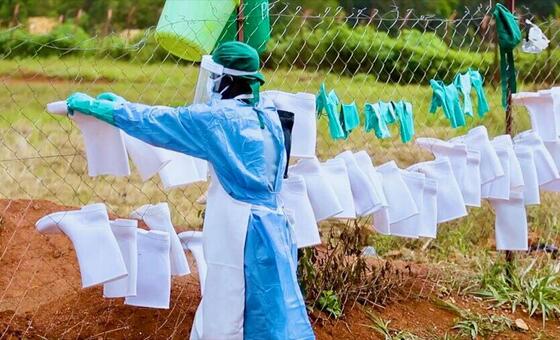
UN agencies are on high alert as the Sudan strain of Ebola reaches displacement camps in DRC, infecting 19 people and killing five.
The Ebola virus has a way of making the world hold its breath, and right now, that breath is coming in short gasps. The United Nations refugee agency (UNHCR) has confirmed that 19 internally displaced people in the Democratic Republic of Congo (DRC) have contracted the Sudan strain of Ebola, and five of them have already died. This isn't just another headline; it's a warning siren for a region already buckling under immense pressure.
We're not talking about a contained cluster in a remote village. This is spreading into displacement camps, where people live shoulder-to-shoulder in temporary shelters with limited access to clean water, sanitation, and healthcare. When a virus like Ebola enters that kind of environment, it doesn't just knock on the door; it kicks it in. The UNHCR has put its humanitarian agencies on high alert, which tells you exactly how serious this situation is becoming.
### Why the Sudan Strain Is Different
You might have heard about Ebola before, but this isn't the same Zaire strain that dominated headlines during the 2014 West Africa outbreak. The Sudan strain is a distinct species of the virus, and here's the kicker: there is no licensed vaccine specifically for it. That's a massive problem for containment efforts.
- The Zaire strain has an effective vaccine (rVSV-ZEBOV) that has been used widely in previous outbreaks.
- The Sudan strain requires a different vaccine, which is still in clinical trials.
- This means health workers are relying on old-school methods: isolation, contact tracing, and safe burial practices.
When you lose the vaccine advantage, every single day counts. The window between identifying a case and stopping transmission shrinks dramatically, and with thousands of people moving through camps, that window is nearly slammed shut.
### The Reality Inside the Camps
The displaced persons camps in eastern DRC are not designed for a biological crisis. They're designed for temporary shelter from conflict, but "temporary" has stretched into years for many families. Overcrowding is the norm, not the exception. You've got families of six or seven living in a space the size of a small living room, sharing latrines with dozens of others, and relying on aid trucks for food and water.
Now, imagine trying to enforce a quarantine in that setting. It's nearly impossible. When people are already living on the edge of survival, telling them to stay in one place while a deadly virus circulates is a tough sell. There's also the trust factor. Many of these communities have been through decades of conflict and have deep skepticism toward outsiders, including health workers. Building that trust takes time, and time is exactly what we don't have.
### The Risk of a Wider Spread
The DRC is no stranger to Ebola, but this outbreak feels different. The fact that it has already reached displacement camps means it's moving along human pathways, not just spillover from wildlife. That's a dangerous shift. The camps are often near major transit routes, and people frequently move between them and larger towns like Goma and Beni, which have international connections.
One case in a city like Goma could trigger a chain reaction that's incredibly hard to break. The UNHCR is not just worried about the camps; they're worried about the entire region, and they have every reason to be. The country is already dealing with measles, cholera, and ongoing armed conflict. Adding Ebola to that mix is like throwing gasoline on a fire that was already burning out of control.
### What Humanitarian Agencies Are Doing
Right now, the response is a mix of urgency and improvisation. Teams are being deployed to the camps to set up isolation units, but they're working with limited resources. There's a scramble to secure doses of the experimental Sudan strain vaccine, but distribution is a logistical nightmare in a region with poor roads and active conflict zones.
- Emergency screening points are being set up at camp entrances to check for fever and symptoms.
- Health workers are going door-to-door, literally tent-to-tent, to track anyone who might have had contact with the infected.
- Public health messaging is being adapted to local languages and cultural practices, especially around burial rituals that can spread the virus.
Despite these efforts, funding gaps remain. The UNHCR has repeatedly called for more international support, but the world's attention is split across multiple crises. It's a stark reminder that global health security is only as strong as its weakest link, and right now, that link is straining hard in eastern DRC.
### What This Means for the Rest of Us
It's easy to look at this from thousands of miles away and feel detached, but the truth is that viruses don't respect borders. The more the virus circulates in a region with weak infrastructure, the higher the chance it mutates into something even more dangerous. The world has a vested interest in stopping this outbreak at its source, not just for humanitarian reasons, but for sheer self-preservation.
The next few weeks are critical. If the containment measures hold, this could be another contained outbreak that fades from the headlines. But if the virus slips deeper into the camps or jumps to a major city, we're looking at a scenario that could dwarf the 2014 crisis. Let's hope the international community acts with the speed and urgency that this moment demands.