Ebola Outbreak Reaches Displaced Camps in Congo: What It Means
Robert Smith ·
Listen to this article~5 min
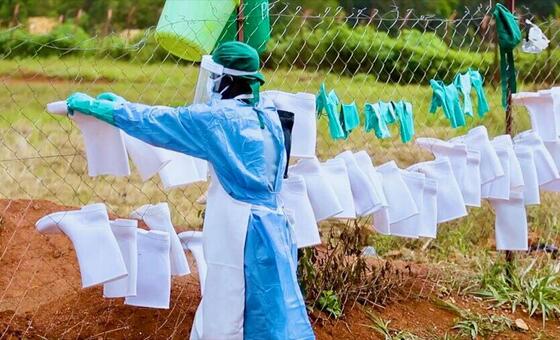
UN agencies are on high alert as the Bundibugyo Ebola strain spreads to displacement camps in the DRC, infecting 19 people and killing 5. Here's what's happening and why it matters.
The United Nations humanitarian agencies are on high alert right now, and for good reason. Reports coming out of the Democratic Republic of the Congo (DRC) show that the fast-moving Bundibugyo strain of Ebola has now infected 19 internally displaced people, five of whom have tragically died. That's according to the UN Refugee Agency (UNHCR), which is tracking the situation closely.
This isn't just another headline about a distant outbreak. This is a story about people who have already lost everything, now facing a virus that thrives in exactly the kind of crowded, resource-strapped conditions they're living in. When Ebola shows up in a displacement camp, the math gets ugly fast.
### Why the Bundibugyo Strain Is Different
You've probably heard of Ebola from the massive 2014 West Africa outbreak that killed over 11,000 people. But the Bundibugyo strain is a different beast. It's less deadly than the Zaire strain that dominated that crisis—mortality rates hover around 25 to 50 percent instead of up to 90 percent—but it's still a nightmare for public health workers.
The real problem isn't the virus itself. It's how it spreads. Ebola moves through direct contact with bodily fluids, which means it spreads fastest where hygiene is poor, where clean water is scarce, and where people live cheek by jowl in makeshift shelters. That's a perfect description of most displacement camps in the DRC.
### The Camp Factor: A Perfect Storm
Here's what makes this outbreak so dangerous. Displaced people in the DRC often have no choice but to crowd into camps with limited sanitation. You're talking about families of six or seven sharing a single tent, with maybe one latrine for every fifty people. Handwashing stations exist, but they're often empty because water deliveries are irregular.
Add to that the fact that many residents are deeply traumatized and distrustful of outsiders, including health workers. When someone shows up in a hazmat suit asking questions, it can feel threatening rather than helpful. That's not a knock on the aid workers—it's just the reality of what decades of conflict do to communities.
### What UNHCR Is Doing Right Now
UNHCR says it's ramping up its response, which includes:
- Deploying additional medical teams to the affected camps
- Setting up isolation units for suspected cases
- Distributing hygiene kits with soap, chlorine, and buckets
- Training local community leaders to spread accurate information about how Ebola spreads and how to prevent it
But here's the uncomfortable truth: these measures are reactive, not proactive. By the time you're setting up an isolation unit, the virus has already had time to move. The goal now is to contain it before it jumps from the camps into the surrounding cities, where the population density is even higher.
### The Bigger Picture
The DRC has been dealing with Ebola outbreaks for decades. This is the 14th one since the virus was first identified near the Ebola River in 1976. Each time, the international community promises to do better, and each time, the response is hampered by funding gaps, security issues, and logistical nightmares.
There's also the question of vaccines. The rVSV-ZEBOV vaccine is highly effective against the Zaire strain, but it doesn't work as well against Bundibugyo. Researchers are working on a multivalent vaccine that would cover multiple strains, but it's still in clinical trials. That means for now, the best tools we have are the basics: surveillance, isolation, and community engagement.
### Why You Should Care
It's easy to think this is a problem happening a world away. But outbreaks don't respect borders. Air travel means a single infected person can carry the virus to another continent in under 24 hours. The DRC's neighbors—including Uganda, Rwanda, and South Sudan—are already on high alert, screening travelers at border crossings.
More importantly, this outbreak is a test. It's a test of whether the global health system has learned anything from past failures. It's a test of whether we can respond to a crisis that doesn't make front-page news until it's already out of control. And so far, the early signs are worrying.
### The Bottom Line
Five people are dead. Nineteen are infected. Those numbers could grow exponentially if the response doesn't get faster and more effective. The people in those camps didn't choose to be there. They fled violence, lost their homes, and now they're fighting for their lives against a virus they didn't ask for.
We'll be watching this story closely because it matters. Not just for the people in the DRC, but for all of us. Because in a connected world, an outbreak anywhere is a threat everywhere.