Gaza's Farmland Crisis: Why Only 3% of Fields Remain Usable
Dr. Isabella Wong ·
Listen to this article~4 min
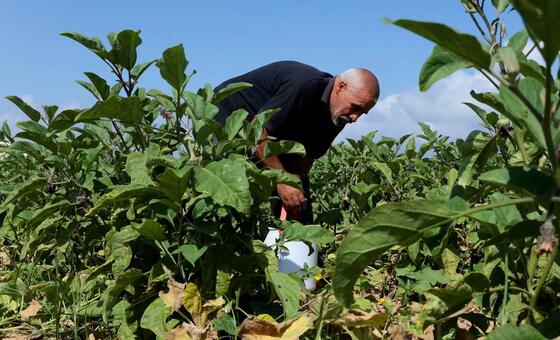
As conflict rages in Gaza, only 3% of arable land remains usable. Farmers face impossible choices as soil contamination, unexploded ordnance, and displacement threaten the region's food supply and future.
The numbers are staggering, and they're not getting better. As conflict continues to rage across Gaza, farmers are facing an impossible reality: finding safe ground to grow food has become a near-impossible task. Recent assessments show that only about 3% of the region's arable land remains fit for cultivation. That's not just a statistic—it's a catastrophe unfolding in real time.
When you think about what that means on the ground, it's hard to wrap your head around it. We're talking about thousands of acres of land that once produced tomatoes, cucumbers, olives, and wheat. Now, much of it is either physically destroyed, contaminated, or simply too dangerous to access. For the families who depend on this land for their livelihoods, the situation is beyond desperate.
### What Happened to the Land?
The damage isn't random. It's the result of sustained military operations that have churned up soil, destroyed irrigation systems, and left behind unexploded ordnance. Even in areas where the ground looks intact, farmers can't be sure it's safe to work. A single misstep could mean stepping on a mine or drawing fire from a distant position.
Beyond the immediate dangers, there's the longer-term problem of soil contamination. Fuel leaks, chemical residues, and the sheer physical compaction from heavy vehicles have degraded the quality of the earth itself. In many places, the topsoil—the layer that actually supports plant life—has been stripped away or rendered useless.
### The Human Cost of a Failed Harvest
Behind every percentage point in that grim 3% figure is a family. A farmer who can't plant can't harvest. A family that can't harvest can't eat, and can't earn. The ripple effects extend far beyond the fields themselves, hitting local markets, food prices, and the broader economy.
- **Food insecurity**: With local production collapsing, reliance on imported aid has skyrocketed.
- **Displacement**: Farmers who lose their land often have no choice but to flee, adding to the already massive refugee crisis.
- **Lost knowledge**: Generations of agricultural expertise are being wiped out as older farmers leave or pass away without passing on their skills.
It's a vicious cycle. The less food that's grown locally, the more dependent the population becomes on external support. And the more the conflict drags on, the harder it is to imagine a path back to self-sufficiency.
### Can the Land Recover?
Soil scientists will tell you that land is remarkably resilient. Given time and the right conditions, even badly damaged earth can be rehabilitated. But time is exactly what Gaza doesn't have right now. And the "right conditions"—peace, security, and investment—are nowhere in sight.
There are efforts underway to document the damage and plan for eventual restoration. International organizations have begun mapping the affected areas, cataloging what's been lost, and identifying what might be saved. But these are long-term projects, measured in years, not months.
> "You can't rebuild a farming community with a few bags of seeds and good intentions," one agronomist working in the region told me. "You need security, you need infrastructure, and you need time. Right now, Gaza has none of those."
### What Comes Next?
For the people living through this, the immediate priority is survival. That means finding ways to grow food in whatever scraps of land remain usable—rooftops, courtyards, even the narrow strips of earth between bombed-out buildings. It's not enough to feed everyone, but it's a start.
For the rest of us, the takeaway is simpler but no less urgent. This isn't just a distant conflict with abstract consequences. It's a real place, with real people, and real soil that's being destroyed. The 3% figure isn't just a number—it's a warning about what happens when we let conflict consume the very ground we stand on.
The road back will be long, and it won't be easy. But understanding what's at stake is the first step toward doing something about it. For now, the fields of Gaza lie mostly silent. The question is whether they'll ever be green again.