UN Official Warns Drones Are Reshaping War After Ukraine Visit
Robert Moore ·
Listen to this article~4 min
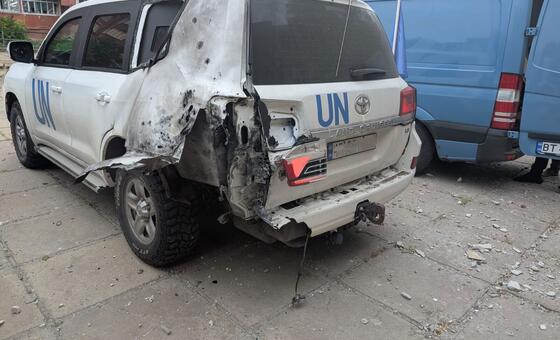
UN relief chief Tom Fletcher warns drones are fundamentally reshaping warfare after witnessing their devastating impact on civilians in Kherson, Ukraine.
When Tom Fletcher, the UN's emergency relief coordinator, wrapped up his latest trip to Ukraine, his message wasn't just about the usual horrors of war. It was about how the battlefield itself is changing right before our eyes. And the epicenter of that change? A city called Kherson.
Fletcher spent two days on the ground there, and what he saw left him with a stark conclusion: drones aren't just a tool of war anymore. They're fundamentally rewriting how conflict is waged against civilians.
### What Fletcher Saw in Kherson
Speaking to reporters via video link from UN headquarters in New York, Fletcher didn't mince words. He called Kherson one of the "epicenters" of drone use against civilian areas. That's not a casual observation. It's a warning.
Think about what that means for a moment. In traditional warfare, you have front lines, artillery, and tanks. But drones change the calculus entirely. They're cheap, they're precise, and they can hover over a residential neighborhood like a hawk waiting for prey. No soldier needs to be within miles of the target.
For the people living in Kherson, that's a daily reality. They're not just dodging shells fired from a distance. They're looking at the sky, wondering if the buzzing sound they hear is a delivery drone or something far more sinister.
### The Human Cost of Drone Warfare
The UN's concern here isn't abstract. When Fletcher talks about drones targeting civilian areas, he's talking about homes destroyed, families torn apart, and infrastructure that keeps people alive—like hospitals and power grids—being systematically knocked out.
Here's what makes this particularly troubling:
- Drones can loiter over a target for extended periods, waiting for the worst possible moment to strike
- They're small enough to evade traditional air defense systems designed for larger aircraft
- The psychological toll on civilians is immense—the constant buzzing creates a state of perpetual anxiety
- They're relatively inexpensive, meaning they can be deployed in massive numbers without breaking a military's budget
That last point is huge. We're not talking about million-dollar missiles here. Some of these drones cost a fraction of what a traditional munition would. That changes the economics of war in ways that should concern everyone.
### Why This Matters Beyond Ukraine
Here's the thing about new tactics in war: they don't stay in one place for long. What's happening in Kherson today could be a blueprint for conflicts elsewhere tomorrow. Militaries around the world are watching closely, taking notes on how drones are being used against civilian populations.
That's not a comforting thought. But it's an honest one.
Fletcher's role as emergency relief coordinator means he sees the direct consequences of these tactics. He's not a military strategist or a defense analyst. He's the guy who shows up after the dust settles to help pick up the pieces. When he says drones are changing the character of war, he's speaking from a position of firsthand experience with the aftermath.
### What Can Be Done?
The UN has been wrestling with drone proliferation for years, but progress has been slow. International law hasn't quite caught up with the technology. There are rules against targeting civilians, but when a drone operator is sitting miles away looking at a screen, the human connection to the act becomes abstract.
That disconnect is dangerous. It makes it easier to cross lines that should never be crossed.
Fletcher's comments aren't just a report on the situation in Ukraine. They're a call to action for the international community to think seriously about how we regulate drone warfare before it becomes the norm rather than the exception.
### The Bottom Line
War has always been brutal, but the tools of brutality keep evolving. Drones represent a fundamental shift in how violence is delivered to civilian populations. And right now, Kherson is ground zero for that shift.
We should all be paying attention to what Fletcher said. Because if drones are changing the character of war in Ukraine, it won't be long before they're changing it everywhere else too.