UN Official's Warning: Drones Are Rewriting the Rules of War
Michael Miller ·
Listen to this article~5 min
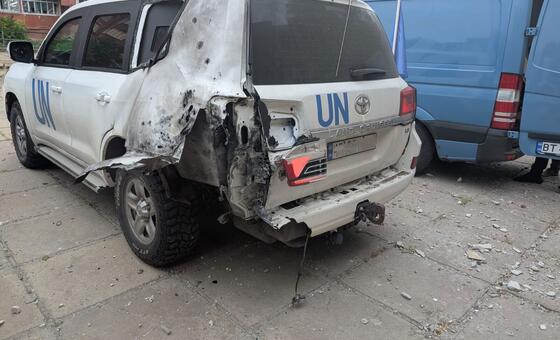
UN relief chief Tom Fletcher warns that drone strikes in Kherson are changing the very nature of modern warfare, calling the city an epicenter of attacks on civilians.
When the United Nations' top emergency relief coordinator wraps up a field visit and immediately calls a press conference, you pay attention. Tom Fletcher, the UN Under-Secretary-General for Humanitarian Affairs, just did exactly that after spending two days in Kherson, Ukraine. His message wasn't about aid corridors or funding gaps—it was something far more unsettling.
He called Kherson one of the "epicenters" of drone strikes against civilian areas. That's not a phrase you hear every day. And it signals a shift that could change how we think about modern conflict.
### What Did the UN Official Actually Say?
Fletcher spoke to journalists via video link from the UN headquarters in New York. He didn't mince words. After visiting Kherson, he described a city where the threat isn't just from artillery or ground troops—it's from the sky, constantly buzzing with drones that target neighborhoods, hospitals, and everyday people going about their lives.
He didn't just call it a problem. He called it a defining feature of this war. In his view, drones have moved from being a tactical tool to something that fundamentally alters the character of warfare itself.
### Why Kherson Matters So Much
Kherson isn't a random city. It sits on the Dnipro River, roughly 60 miles northeast of the Black Sea coast. It's been a flashpoint since the early days of the invasion, changing hands multiple times. Today, it's a frontline city—and that makes it a testing ground for new military tactics.
What Fletcher saw there wasn't just sporadic attacks. It was a pattern. Drones being used systematically against civilian infrastructure and populated areas. That's a significant departure from how wars were fought just a decade ago.
### The Bigger Picture: How Drones Change Everything
Here's the thing about drones that makes them so different from traditional weapons:
- **They're cheap.** A single drone can cost a few hundred dollars, while the missile it replaces might cost hundreds of thousands.
- **They're precise—or not.** The same technology that can hit a specific target can also be turned on a school or a market.
- **They're everywhere.** Unlike jets or helicopters, drones don't need runways. They can be launched from anywhere, by anyone.
- **They're psychological.** The constant buzzing overhead creates a level of fear that traditional bombing doesn't match.
That last point might be the most important. When you hear a drone overhead, you don't know if it's watching, recording, or about to strike. That uncertainty is a weapon in itself.
### What This Means for Civilians
For the people of Kherson, this isn't an academic debate. It's daily life. Fletcher's visit was about assessing humanitarian needs, but what he found was a population living under a new kind of siege—one that comes from the sky and never really stops.
The UN's role here is to document, to report, and to push for accountability. But Fletcher's comments suggest something more urgent: that the international community needs to wake up to this new reality before it becomes the norm in conflicts everywhere.
### A Turning Point for Modern Warfare?
It's easy to dismiss this as just another grim update from a brutal war. But Fletcher's choice of words—"changing the character of war"—carries weight. He's not just describing a tactic. He's describing a transformation.
If drones can turn a city like Kherson into a permanent danger zone, what does that mean for other cities? For other conflicts? For the future of urban warfare?
These are questions the UN, military strategists, and policymakers are going to have to grapple with. And if you're watching from the outside, it's worth understanding: the next war might not look like the last one. It might look like Kherson.
### The Takeaway
Fletcher wrapped up his trip with a clear warning. Drones aren't just a tool in this war—they're reshaping it. For civilians in frontline cities, that means a new kind of terror. For the rest of us, it's a glimpse of what conflict could look like in the years ahead.
The UN's next steps will be critical. But for now, his words stand as a stark reminder: the rules of war are being rewritten, and we're all just beginning to understand what that means.