A Top UN Official Just Revealed How Drones Are Rewriting the Rules of War
Eleanor Vance ·
Listen to this article~4 min
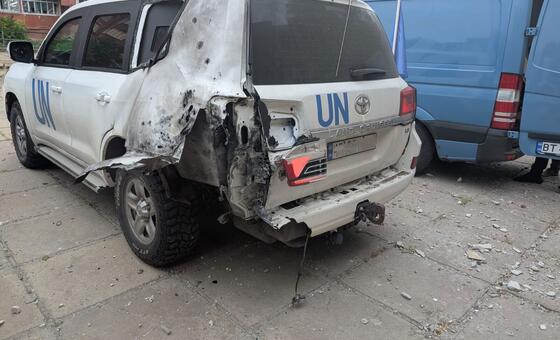
UN humanitarian chief Tom Fletcher just wrapped up a trip to Ukraine, and his warning about drones in Kherson is a stark look at how modern warfare is changing—and what it means for civilians everywhere.
When Tom Fletcher, the UN's Under-Secretary-General for Humanitarian Affairs, wrapped up his latest trip to Ukraine, he didn't just deliver a standard diplomatic briefing. Instead, he pointed to something that should stop us all cold: the way drones are fundamentally changing what war looks like on the ground.
Fletcher spent two days in Kherson, a city he described as one of the "epicenters" of drone attacks against civilian areas. That's not a term these officials throw around lightly. It's a direct, sobering acknowledgment that the front lines of modern conflict aren't just trenches and tanks anymore—they're the skies above neighborhoods, hospitals, and apartment blocks.
### What Did the UN Official Actually Say?
Speaking via video link to reporters at the UN headquarters in New York, Fletcher didn't mince words. He's not a military strategist or a defense contractor; he's the guy responsible for coordinating emergency relief. So when he talks about drones, he's talking about what they mean for the people trying to survive.
His core takeaway was simple: drones are changing the character of war. Not the fact of war—unfortunately, that hasn't changed—but the way it's fought, who's at risk, and how civilians experience it.
### Why Kherson Matters So Much
Kherson isn't just another city on a map. It's a place where the distinction between "front line" and "civilian life" has practically vanished. Fletcher's visit there wasn't ceremonial. It was about seeing, firsthand, how the constant threat from above is shaping daily existence.
Think about what that means for a family there:
- You can't predict when a drone might appear overhead.
- You can't tell if it's surveillance or a strike.
- You can't rely on early warning systems that were designed for missiles, not small, agile aircraft.
- You can't even find safety in numbers, because crowded areas are often the primary targets.
That's a terrifying new reality, and it's one that humanitarian workers have to adapt to every single day.
### The Shift From Battlefield to Backyard
For decades, air power meant heavy bombers or fighter jets flying at high altitudes. They were destructive, sure, but they were also predictable in a way. You could hear them coming. You could seek shelter.
Drones have flipped that script. They're quiet, they're cheap, and they can hover over a single street for hours. They turn every corner of a city into a potential target zone. This isn't just a tactical shift; it's a psychological one. It erodes the sense of safety that people cling to even in the midst of war.
### What This Means for the Rest of Us
The implications don't stop at Ukraine's borders. What's being tested and refined there is a playbook that could be used anywhere. The technology is getting cheaper, more accessible, and more autonomous by the day. That's a sobering thought for anyone who believes that geographic distance offers protection.
> "We are watching the future of conflict unfold in real time, and it's happening over civilian neighborhoods."
That's the uncomfortable truth Fletcher's comments point to. It's not about predicting what comes next; it's about acknowledging that the rules we thought governed war are being rewritten, and we're all just trying to catch up.
### A Call for Global Attention
Fletcher's trip wasn't just about gathering data for a report. It was a reminder that the international community needs to pay closer attention to how these weapons are used. The laws of war were written for a different era. They don't fully account for a world where a $500 drone can level a building or terrorize a city block.
It's a complex problem, and there are no easy answers. But the first step is understanding the problem clearly. And that starts with listening to people like Fletcher who are on the ground, seeing the damage, and telling us the truth about what modern warfare really looks like.