UN Official Warns Drones Are Rewriting the Rules of War in Ukraine
Wouter Vermeer ·
Listen to this article~5 min
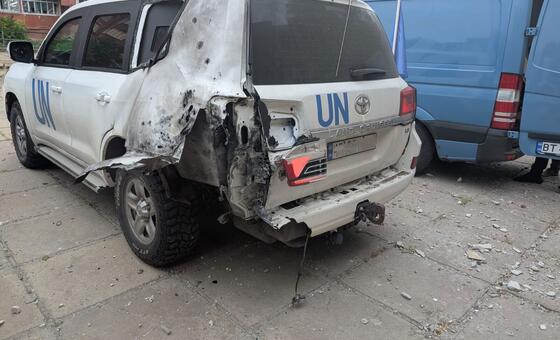
A top UN official just returned from Ukraine with a stark warning: drones are changing the very nature of warfare, turning civilian areas into new frontlines. Here's what he saw in Kherson.
When you think about how wars are fought, you probably picture tanks rolling across open fields or fighter jets screaming through the sky. But according to a top United Nations official who just wrapped up a fact-finding trip to Ukraine, the real game-changer right now is something much smaller, much cheaper, and frankly, much more unsettling: drones.
Tom Fletcher, the UN's Under-Secretary-General for Humanitarian Affairs and Emergency Relief Coordinator, spent his final two days in the southern city of Kherson. Speaking to reporters via video link from UN headquarters in New York, he didn't mince words. He called Kherson one of the "epicenters" of drone use against civilian areas.
That's a chilling phrase, and it's worth unpacking. Because when we talk about drones in modern warfare, we're not just talking about reconnaissance or precision strikes on military targets. We're talking about a fundamental shift in how danger reaches ordinary people.
### Why Kherson Matters So Much Right Now
Kherson isn't just another city on a map. It's a frontline city, sitting right on the Dnipro River, and it has been battered by conflict for years. What Fletcher saw there is a pattern that's becoming all too familiar: drones being used not just to gather intelligence, but to actively target residential neighborhoods, schools, and infrastructure that civilians depend on.
The significance here goes beyond the immediate destruction. Drones are changing the psychology of war. In the past, civilians might have had some warning before an artillery barrage or an airstrike. They could hear the planes or the incoming shells. But a small drone can be virtually silent until it's right on top of you. That creates a constant, gnawing sense of vulnerability that's almost impossible to escape.
### The Human Cost of Drone Warfare
Fletcher's comments highlight a grim reality: the tools of war are getting cheaper, but the human cost is getting heavier. A single drone might cost a few thousand dollars, but the damage it does to a community—in terms of lives lost, homes destroyed, and the psychological toll on survivors—is measured in ways that can't be quantified in a budget.
During his visit, Fletcher didn't just talk to officials. He talked to people who are living through this every day. He saw the aftermath of strikes and heard firsthand what it's like to wonder if the buzzing sound overhead is just a bird or something far more sinister. It's a reminder that behind every statistic about drone warfare, there's a family trying to figure out how to get through the night.
### What This Means for the Future of Conflict
This isn't just a story about Ukraine, even though it's the most visible example right now. What's happening in Kherson is a preview of what future conflicts might look like everywhere. Drones are leveling the playing field in some ways, allowing smaller forces to cause outsized damage. But they're also blurring the lines between combatants and civilians in ways that international law is struggling to keep up with.
Some of the key takeaways from Fletcher's trip that are worth keeping in mind:
- **Civilian infrastructure is increasingly in the crosshairs** — power grids, water systems, and homes are all being targeted with drone strikes, not just military bases.
- **The psychological impact is immense** — the constant threat of an unseen attacker creates widespread anxiety and trauma, especially among children.
- **Humanitarian access is getting harder** — when drones make roads and cities dangerous, aid workers can't safely reach the people who need help the most.
- **The cost of defense is skyrocketing** — communities are being forced to invest in counter-drone technology just to feel a semblance of safety.
### A Call for Action, Not Just Observation
Fletcher's report isn't meant to be a dry diplomatic summary. It's a warning. He's calling on the international community to pay attention and to find ways to protect civilians from this evolving threat. The laws of war were written for a different era, and they're being tested in real time by this new technology.
As he wrapped up his video briefing, the message was clear: the character of war is changing, and if we don't adapt our thinking and our rules, the price will be paid by the most vulnerable people on the ground. It's a sobering thought, but it's one we can't afford to ignore.